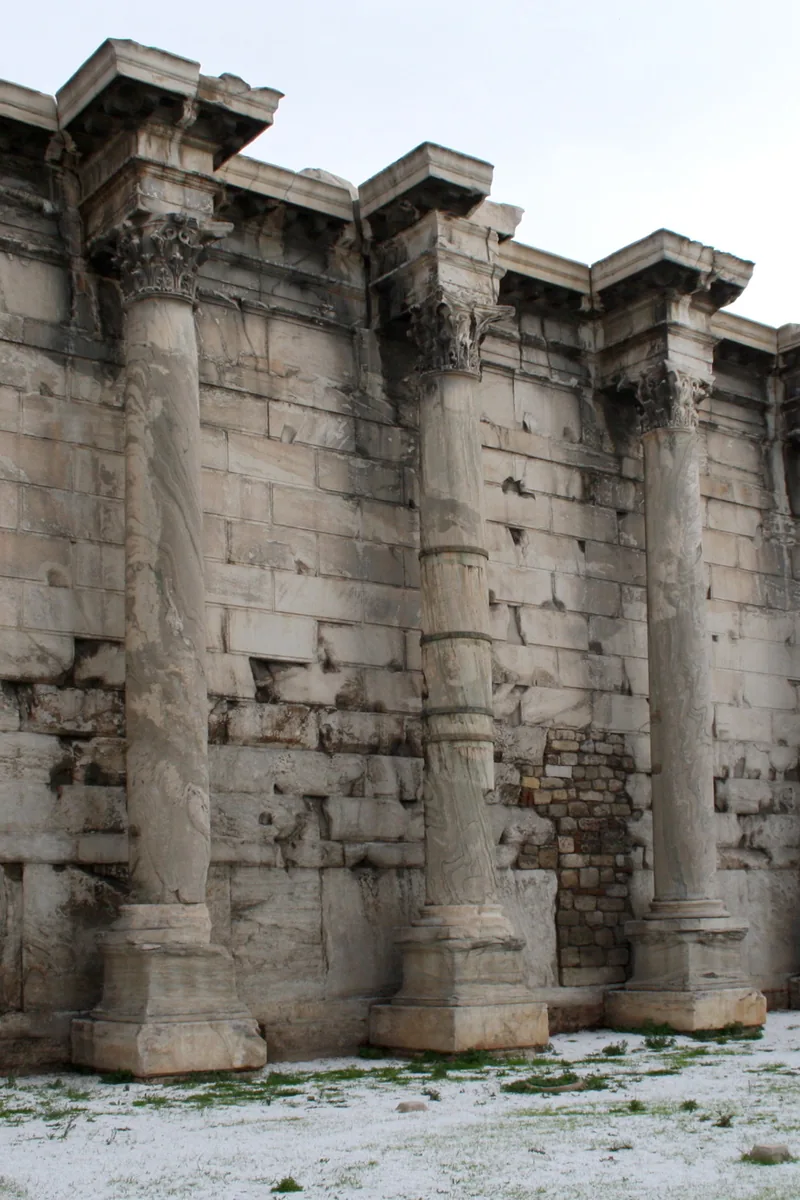
The surviving west façade of Hadrian's Library in Athens, a row of Corinthian columns standing before the marble wall in the Monastiraki district

Step inside the marble library the Emperor Hadrian gave to Athens

Hadrian's Library skip-the-line timed entry — the vast colonnaded courtyard the Roman emperor raised in the heart of Athens around 132 AD, its landmark west façade of Corinthian columns rising above Monastiraki. We reserve your dated hourly slot so you walk past the ticket-office queue straight to the gate.

See ticket options
  • c.132 AD Built by Emperor Hadrian
  • 122 m Length of the marble enclosure
  • 100 Columns ringed the courtyard
  • 2 min Walk from Monastiraki metro

Choose your ticket

  • Book in your languageYour currency, final price.
  • Pro tips includedBest slots, the details most visitors rush past.
  • Ready before you flyMobile ticket, ready in your inbox.
  • 24/7 human supportReal people, any hour, any time zone — 24/7, in your own language, right through to your visit day.
4.8 from 116 verified travellers
Sophie R.
Manchester, England
“We showed our phones at the gate and walked straight in while a walking-tour group waited at the ticket office. Standing before the Corinthian columns of the façade, then finding the little churches built inside the courtyard, was a lovely surprise in the middle of the city. The short audio history beforehand made every ruin make sense.”
May 2026
David M.
Sydney, Australia
“Booking and picking our hourly slot was so easy. We took an early slot and had the courtyard almost to ourselves before Monastiraki filled up. It's compact, so we paired it with the Roman Agora next door for a perfect ancient-Athens morning.”
April 2026
Anna L.
Hamburg, Germany
“The open courtyard gets hot fast at midday, so go early. Reserving our slot ahead meant no queuing in the heat. The row of columns on the façade and the outline of the old reflecting pool were my favourites — a quiet spot right off the busy square.”
June 2026

Audio guide · 5-minute

Your 5-minute Hadrian's Library pre-visit briefing

A short, calm narrative — the marble cultural centre the Emperor Hadrian gave to Athens, the great courtyard and its garden, the library where scrolls were kept in wall niches, the churches later built inside, and what to look for as you walk the ruins. Listen on the metro to Monastiraki or as you reach the gate.

Included with your booking — your full guide arrives with your ticket.Get your guide
  • Around 132 AD — the Emperor Hadrian raises his greatest Athenian building, a cultural centre as much as a library
  • The monumental west façade with its Corinthian columns — the grand gateway and the site's enduring landmark
  • A courtyard ringed by a hundred marble columns, with a long ornamental pool and garden at its heart
  • The library proper — scrolls stored in tiers of niches set into the walls, with reading and lecture rooms nearby
  • Later centuries — the early Christian Tetraconch and the church of the Megali Panagia built within the walls
  • Best timing: take the first or last hourly slot to beat the heat and the walking-tour crowds in Monastiraki

Recorded for Hadrian's Library Tickets concierge. Free to download.

About Hadrian's Library

Hadrian's Library is the grand marble complex that the Roman emperor Hadrian raised in the centre of Athens around 132 AD, the largest single structure he built in the city he loved. Far more than a library in the modern sense, it was a vast rectangular enclosure — roughly 122 by 82 metres — built as a cultural and intellectual centre for the city: a colonnaded courtyard for study and conversation, halls for lectures and readings, and, at its eastern end, the library proper, where papyrus and parchment scrolls were kept in tiers of niches set into the walls. It stands in the Monastiraki and Plaka district, just north of the Roman Agora and beside the Ancient Greek Agora, at the very heart of old Athens.

The enclosure was entered from the west through a monumental gateway, and it is a stretch of that west façade — a line of tall Corinthian columns standing before the marble wall — that survives as the landmark you see today from the square below. Inside, a peristyle of around a hundred columns of coloured marble ringed a great open courtyard with a long ornamental pool and garden at its centre, a serene space set apart from the noise of the city. Over the following centuries the complex was damaged, rebuilt and reused, and in Byzantine times several churches rose within its walls — among them the early Christian Tetraconch and, later, the church of the Megali Panagia — so that the ruins layer Roman grandeur with the Christian city that grew up inside it.

Hadrian's Library sits at the crossroads of ancient Athens, a two-minute walk from the Monastiraki metro station and within easy reach of the Acropolis, the Roman Agora and the Ancient Greek Agora, all of which lie close by. It is easily confused with its neighbours — the Roman Agora and the Greek Agora are separate sites with their own tickets — but the Library is a distinct enclosure of its own, and this ticket is entry to it alone. Because entry is now timed by the hour, we handle the ticketing in your own language and reserve the slot you want, so you can give your energy to the ruins instead of the queue.
Practical information

Opening hours
Open daily, year-round. Summer (roughly April–October) approx. 08:00–20:00; winter (November–March) shorter daytime hours, often around 08:30–17:00. Entry is timed by the hour and last entry is about 30 minutes before closing. Hours are set by the operator and change seasonally and on public holidays — confirm on the day of your visit.
Address
Archaeological Site of Hadrian's Library, Areos 3, Monastiraki, Athens 105 55, Greece.
Getting there
Hadrian's Library is in the heart of old Athens, on Areos street between Monastiraki Square and the Roman Agora. The nearest metro is Monastiraki on Lines 1 (green) and 3 (blue), about a two-minute walk from the entrance. From most central hotels in Plaka, Monastiraki or Psyrri it is an easy stroll. The Acropolis, the Roman Agora and the Ancient Greek Agora are all within a few minutes' walk, but they are separate sites with separate tickets.
Accessibility
A compact open-air archaeological site on largely level ground in the city centre, with gravel, marble paving, low ruins and some uneven surfaces. Sun exposure across the open courtyard is high and shade is limited. Sturdy shoes, a hat and water are recommended; visitors with limited mobility can see much of the site from the level walkways, though some areas have rough or stepped ground.
Bag policy
Day bags are fine. There is no large-luggage storage on site, so leave suitcases at your accommodation. Please keep to the marked paths and do not climb on the ruins.
Photography
Personal photography is welcome across the site. Tripods, professional equipment and drones may require permission, and climbing on the monuments is not allowed.

About our service

Hadrian's Library Tickets is an independent concierge service that helps international visitors reserve and receive their timed-entry tickets in English. We are not the archaeological site and we are not an official vendor — we purchase genuine entry tickets on your behalf from the Hellenic Ministry of Culture's official ticketing service, and our service fee is included in the price you see. If you prefer to buy directly, the operator's own ticket site is tickets.hh.gr.

Frequently asked

Is this a skip-the-line ticket?

Your hourly slot is reserved before you arrive, so you walk straight to the site gate instead of queuing at the Hadrian's Library ticket office. On busy days that small ticket office backs up as walking tours and cruise groups arrive in Monastiraki, so coming with your ticket already in hand saves the wait in the sun.

How does the timed entry work?

You choose the date and an hourly time slot, and your ticket is valid for a single entry during that hour on that day. Just arrive within your slot window and show your mobile ticket at the gate; last entry is about 30 minutes before closing.

What's included in the ticket?

Full admission to the Hadrian's Library archaeological site — the surviving west façade with its Corinthian columns, the great colonnaded courtyard with its garden and ornamental pool, the remains of the library and its reading and lecture rooms, and the early Christian churches built within the enclosure. It is entry to the Library site itself; the neighbouring Roman Agora and Ancient Greek Agora are separate sites with their own tickets.

Is this the same as the Roman Agora or the Greek Agora?

No. Hadrian's Library is a distinct site just north of the Roman Agora and beside the Ancient Greek Agora. The three sit close together in Monastiraki and Plaka and are easy to confuse, but each is a separate enclosure with its own entrance and ticket. This ticket admits you to Hadrian's Library only.

What exactly was Hadrian's Library?

It was a monumental cultural centre the Emperor Hadrian gave to Athens around 132 AD — the largest building he raised in the city. As well as the library where scrolls were stored in wall niches, it held a great colonnaded courtyard with a garden and pool, and halls for lectures and reading, making it a place of study and philosophy rather than only a store of books.

How and when do I get my ticket?

We send your ticket to your email as a mobile ticket once your booking is confirmed — there's nothing to print, just show it on your phone at the gate. You'll also receive a short 5-minute audio history to listen to before you go.

How do I get to Hadrian's Library?

Hadrian's Library is in the centre of old Athens, on Areos street between Monastiraki Square and the Roman Agora. The nearest metro is Monastiraki on Lines 1 and 3, about a two-minute walk from the entrance. From most central hotels in Plaka, Monastiraki or Psyrri it is an easy stroll.

What is the landmark row of columns I can see from the square?

That is a surviving stretch of the west façade of the complex — the monumental front wall through which the Library was entered, with its tall Corinthian columns standing before the marble. It is the most photographed part of the site and the clearest sign of the scale and richness of the building Hadrian raised.

Are there churches inside the ruins?

Yes. In later centuries several churches were built within the enclosure. In early Christian times a large four-apsed church, the Tetraconch, rose in the courtyard, and later the small church of the Megali Panagia stood on the site. Their remains layer the Roman ruins with the Christian city that grew up inside them.

When is the best time to visit?

Book the first hourly slot after opening, or one of the last slots before closing. The courtyard is open with limited shade, so the middle of a summer day is both the hottest and the busiest stretch, when walking tours and cruise groups pass through Monastiraki. An early or late slot gives cooler air, softer light and a calmer walk among the ruins.

How long should I allow for the visit?

Most visitors spend about 30 to 45 minutes at Hadrian's Library, taking in the west façade, the courtyard, the library remains and the churches. It is a compact site, so many people pair it with the Roman Agora, the Greek Agora or the Acropolis close by to make a fuller morning of ancient Athens.

Do I need to bring my passport or any ID?

No. The standard entry ticket is not personalised and needs no passport or name — just show your mobile ticket at the gate. (Reduced and free-entry categories set by the operator may require ID at the gate; our ticket is standard full admission.)

Is the site wheelchair accessible?

Partly. Hadrian's Library is a compact site on largely level ground, so much of it can be seen from the marked walkways, but there are areas of gravel, marble paving and low ruins with uneven or stepped surfaces. Visitors with limited mobility can see a good deal of the site but should allow extra time and expect some rough ground.

Is Hadrian's Library open all year?

Yes — the site is open daily, year-round. Only the daily hours change with the season: longer in summer (roughly 08:00–20:00) and shorter in winter, with timed entry by the hour and last entry about 30 minutes before closing. Hours can change on public holidays, so confirm on the day.

Can I change my slot after booking?

Changes are allowed up to 2 hours before your visit, with a maximum of 2 changes per ticket, provided your preferred new slot is still open. If your plans shift, contact our team and we'll help where the operator's rules allow. See our terms for the full policy.

Can I get a refund?

All bookings are final once confirmed; we only issue a refund in the rare event the operator cannot honour a validly issued ticket. Timed-entry tickets are non-refundable, but you can change your slot up to 2 hours before your visit within the operator's rules. See our terms for details.

Are you the official Hadrian's Library ticket office?

No. We're an independent concierge service for international visitors. We buy genuine tickets on your behalf from the Hellenic Ministry of Culture's official ticketing service and handle the booking in your own language, and our service fee is included in the price shown. You can always buy directly from the operator if you prefer.

What currency am I charged in?

The price you see is the price you pay — we show it in your local currency where we can and charge exactly that amount, with no surprise fees at checkout. Payment is by card on a secure page.